
Last Updated on: 6 August 2026 | Last Reviewed on: 6 August 2026
Key takeaways at a glance
- Who is covered: the financial services of India Post, principally the Post Office Savings Bank and the postal money transfer and remittance services, as reporting entities under the PMLA.
- Why they are caught: India Post’s savings, deposit and remittance services are financial services that make it a reporting entity under section 2(1)(wa) of the PMLA.
- Governing laws: the PMLA, 2002 and the PML (Maintenance of Records) Rules, 2005; the Department of Posts KYC/AML/CFT norms for the Post Office Savings Bank and the Money Transfer Service Scheme; the UAPA 1967 (Section 51A) and the WMD Act, 2005 (Section 12A).
- Supervisor: the Department of Posts. Reports go to the Financial Intelligence Unit India (FIU IND); the Enforcement Directorate (ED) enforces the PMLA.
- Core duties: customer identification and KYC, beneficial owner identification, ongoing monitoring, cash and suspicious transaction reporting, five year record keeping and sanctions screening.
This guide is general information on Indian law, not legal advice. For your specific position, speak to a qualified AML professional.
India Post is a reporting entity under the Prevention of Money Laundering Act, 2002 for its financial services. Through the Post Office Savings Bank, it operates savings and small savings deposit schemes across the country, and through the money transfer service scheme and international money transfer, it pays out cross border personal remittances.
These are the financial services that bring India Post within the anti money laundering law, and its AML, CFT and CPF duties flow from the PMLA, the PML (Maintenance of Records) Rules, 2005, the Department of Posts KYC, AML and CFT norms, Section 51A of the UAPA, Section 12A of the WMD Act, and the FIU IND reporting framework. The Department of Posts supervises these services, and reports are filed with FIU IND.
The core instruments at a glance
| Instrument | What it does for India Post |
| PMLA, 2002 | The prime Act. Makes India Post a reporting entity for its financial services and creates the core duties of CDD, record keeping and reporting. |
| PML (Maintenance of Records) Rules, 2005 | Defines what to report and when, how to identify customers and beneficial owners, and the duty to appoint officers. |
| Post Office Savings Bank KYC/AML/CFT norms (25 May 2023) | The Department of Posts norms for KYC and AML in the postal savings bank, the sector rulebook. |
| Money Transfer Service Scheme Master Direction | Governs the inbound cross border remittance service India Post operates. |
| UAPA Section 51A and WMD Act Section 12A | Impose targeted financial sanctions for terrorism and proliferation financing. |
| FATF Recommendations 9 to 23 (with Recommendation 14) | The international preventive measure standards, including the standard for money or value transfer services. |
What Financial Services of India Post are Covered?
India Post is a department of the Government of India, but for anti money laundering purposes it is its financial services that matter. The Post Office Savings Bank offers savings accounts and the national small savings schemes, taking deposits from a very large customer base that reaches deep into rural India.
The money transfer service scheme and international money transfer arrangements pay out inbound cross border personal remittances at post office counters. It is these deposit and remittance services that make India Post a reporting entity; the ordinary postal and mail services are not financial services and are outside this framework. India Post Payments Bank, a separate payments bank, is covered under the banking framework.
The money laundering and terrorist financing risk of India Post’s financial services is the risk of a large, cash based savings and remittance network. Small savings deposits can be used to place cash, a wide branch network and a rural customer base can make identification difficult, and inbound remittance can move value across borders. The framework therefore leans on identifying the customer at account opening and at remittance payout, on watching for structuring across the network, and on screening against sanctions lists.
Is India Post a Reporting Entity under the PMLA?
Yes, for its financial services. The Prevention of Money Laundering Act, 2002 creates the offence of money laundering and places core duties on reporting entities. India Post’s Post Office Savings Bank and certain remittance services and other financial services fall within the financial services framework under the PMLA, making India Post a reporting entity under section 2(1)(wa). Accordingly, the Department of Posts has issued KYC, AML and CFT norms for them. Its mail and courier operations are not financial services and are not covered on this basis.
This places India Post’s financial services in the same broad category of reporting entities that file with FIU IND as banks and other financial institutions, and within the wider AML laws and regulations for financial institutions in India.
Supervisory Authority for India Post in India
The supervisor for India Post’s financial services is the Department of Posts itself, which is housed under the Ministry of Communications, which operates the Post Office Savings Bank and the postal remittance services and sets their KYC and AML norms.
On 25 May 2023, the Department revised the KYC, AML and CFT norms for the Post Office Savings Bank, and it operates the money transfer service scheme under a master direction. Unlike NBFCs, which the RBI supervises, or insurers, which the IRDAI supervises, India Post’s financial services are supervised within the postal department.
India Post files reports with the Financial Intelligence Unit India, which receives, analyses and disseminates them, while the Enforcement Directorate investigates and prosecutes the offence of money laundering under the PMLA.
Onboarding clients without a documented due-diligence process?
AML India can put client due diligence, beneficial-ownership checks and suspicious-transaction reporting in place for your practice, keeping you audit-ready without slowing your engagements down.
AML Regulatory Requirements for India Post in India
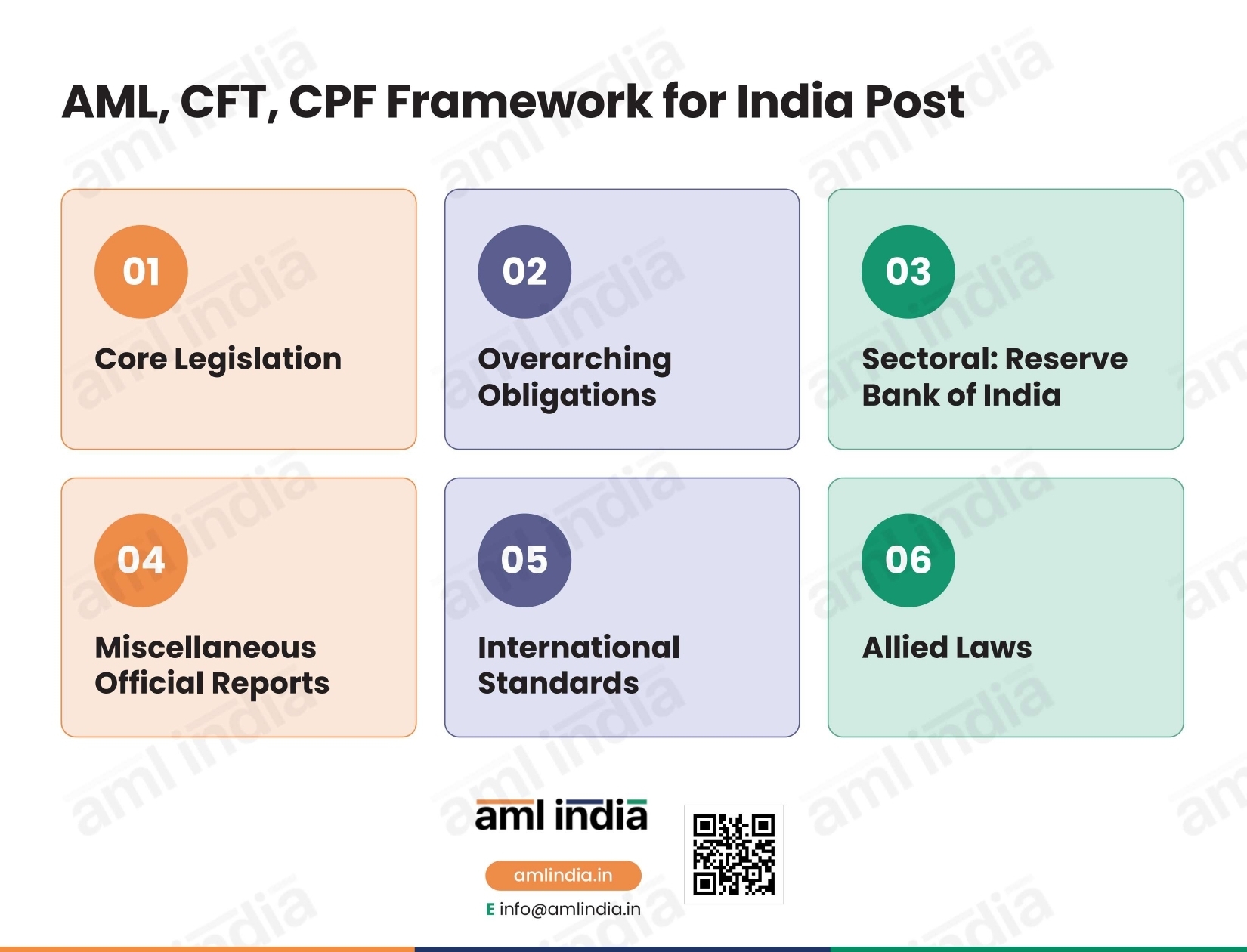
The law that governs India Post does not sit in one place. It is a framework which consists of different layers: the core legislation, the overarching obligations, the sectoral supervisor and its directions, the miscellaneous official reports, the international standards, and the allied laws. Each category below lists the instruments that apply, with a short note on what each does for India Post.
The framework reads from the core. The PMLA is the parent Act; the PML Rules turn it into operational duties; the RBI Directions outline the instructions India Post can follow; the UAPA and the WMD Act add counter terrorism and proliferation financing sanctions; and the allied laws, including each institution’s own establishing statute, shape the risk. The risk based approach supports the entire framework.
Core Legislation
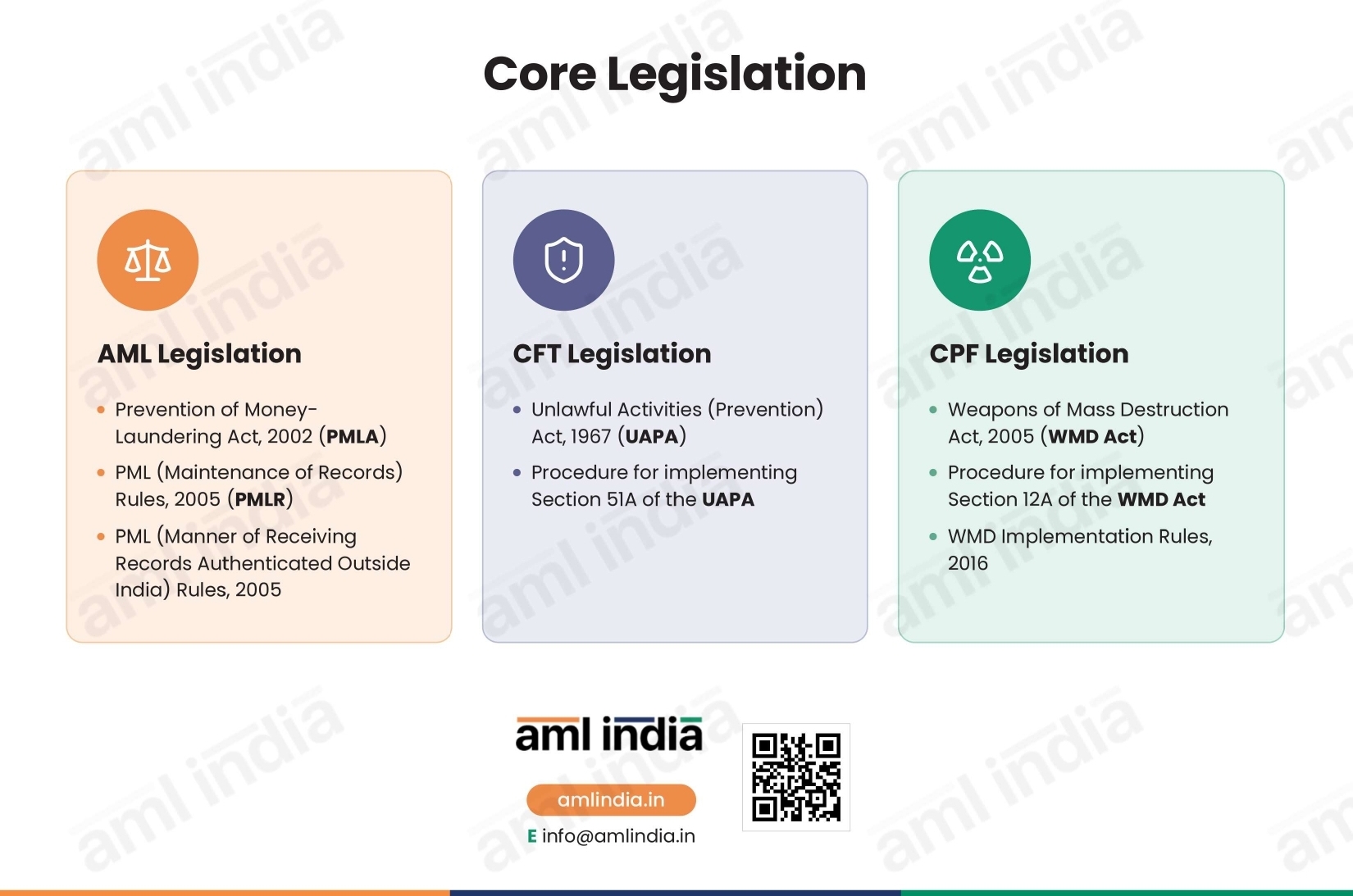
The primary statutes and rules that create the AML, CFT and CPF obligations are grouped into three categories.
AML Legislation
Prevention of Money Laundering Act, 2002 (PMLA)
India’s main AML statute and the source of India Post’s reporting entity status. It outlines the offence of money laundering and imposes the duties, customer due diligence under Section 11A and record keeping under Section 12, that India Post must comply with in its savings and remittance services. Because it takes savings deposits and pays out remittances across a very wide, cash based network, its exposure sits at account opening and remittance payout and in the risk of structuring across branches, which is where the Act chimes in.
The PML (Maintenance of Records) Rules, 2005 (PMLR)
The rules that operationalise the PMLA. It explicitly identifies several core AML obligations that are to be undertaken. This includes reporting requirements under Rule 3 and 8, customers and beneficial ownership requirements under Rule 9 and the appointment of Principal Officer and Designated Director under Rule 7. The PMLR has been amended through 31 Gazette notifications .
The 31 PMLR Amendment Notifications, in Date Order:
| Gazette notification and date | Key change or rule touched |
| G.S.R. 389(E), 24 May 2007 | One of the earliest amendment that widened the scope of Rule 2 on suspicious transaction to include dealings that lack economic rationale, bona fide purpose or hint towards terrorism financing among other changes. |
| G.S.R. 816(E), 12 November 2009 | A broad reset that brought in the non profit organisation and Regulator definitions, reset the suspicious transaction, and required reporting of NPO receipts over Rupees 10 lakh. Additionally, under Rule 6 it set ten year retention, and it reset Rule 9 to require beneficial owner identification, ongoing due diligence, a ban on anonymous accounts and a Client Identification Programme. |
| G.S.R. 76(E), 12 February 2010 | Adjusted Rules 3, 4, 5 and 7 to further reinforce compliance measures such as record keeping and the reporting references and, added the an explanation in Rule 9(1A), which reads the beneficial owner as the natural person who ultimately owns or controls a client or on whose behalf a transaction is made. |
| G.S.R. 508(E), 16 June 2010 | Reset Rules 2, 9 and 10, the provisions on definitions, customer due diligence and record keeping, revising the manner of identifying customers for reporting entities and what records it holds. |
| G.S.R. 980(E), 16 December 2010 | Set up the regime for small accounts, defining the Designated Officer and the small account, recognised the NREGA job card and the Aadhaar letter as officially valid documents in Rule 2, and added Rule 9(2A) on how such an account is opened and monitored. |
| G.S.R. 481(E), 24 June 2011 | Introduced short title PMLR for Prevention of Money Laundering (Maintenance of Records) Rules. |
| G.S.R. 576(E), 27 August 2013 | Amended Rules 2 and 3 and added provisions after Rule 10,for definitions, reporting duties for the cash and suspicious transaction and the record framework so they match the reporting obligations. |
| G.S.R. 288(E), 15 April 2015 | Reset the definitions contained under Rule 2 definitions; because definitions set who and what the operative rules reach. This opened gates for a slew of updates in 2015. |
| G.S.R. 544(E), 7 July 2015 | Reset Rules 2, 9 and 10 on definitions, customer due diligence and record keeping, changing how a reporting entity identifies customers and what records it holds, within a substantial 2015 overhaul of the CDD and records provisions. |
| G.S.R. 730(E), 22 September 2015 | Revisited the definitions contained Rules 2 and 7 on the requirement for a Principal Officer and an internal reporting mechanism. |
| G.S.R. 882(E), 18 November 2015 | The final amendment notification for the year 2015 which focused on changing the definitions and reporting provisions, changing how key terms are read and how transactions reach the FIU. |
| G.S.R. 347(E), 12 April 2017 | Amended Rule 2 and introduced Rule 9A to incorporate Central KYC Records Registry into the Rules. This established the obligation to upload customer KYC records to a central repository and enabled their reuse across reporting entities laying the structural foundation for today’s CKYCR. |
| G.S.R. 538(E), 1 June 2017 | Changed Rules 2 and 9 pertaining to definitions and Aadhar number. |
| G.S.R. 1038(E), 21 August 2017 | Reset the Rule 2 definitions, changing the defined terms that govern how the operative rules apply, among several definition updates in 2017. |
| G.S.R. 1318(E), 23 October 2017 | The last amendment introduced in 2017 pertaining to Rule 2A. |
| G.S.R. 456(E), 16 May 2018 | It made revisions to the definitions and customer due diligence provisions, and other measures. |
| G.S.R. 1078(E), 31 October 2018 | It reset the timeline set under Rule 9 from three days to ten days. |
| G.S.R. 108(E), 13 February 2019 | It introduced amendments to Rules 2 and 9 and its respective sub-rules. |
| G.S.R. 381(E), 28 May 2019 | It changed Rule 9 by introducing the requirement of signature or thumb print in an exceptional case outlined through this amendment notification. . |
| G.S.R. 582(E), 19 August 2019 | It amended Rules 2 and 9 and prompted the addition of Annexture 1 after Rule 11. |
| G.S.R. 669(E), 18 September 2019 | This amendment notification introduced amendments to Rules 2 and 9 and incorporated an explanation for Rule 9. |
| G.S.R. 840(E), 13 November 2019 | This reset Rule 9 by outlining the additional requirement for an client to be undertaken by a reporting entity in an exceptional case that is outlined by this amendment. |
| G.S.R. 228(E), 31 March 2020 | This notification explicitly stated the operational period for small account which would be subject to other periods and notifications by the Government. |
| G.S.R. 251(E), 13 April 2020 | It revised Rule 8 and set the timeline for the Reporting Officer to furnish information. |
| G.S.R. 254(E), 16 April 2020 | A follow up Rule 8 reset days after the previous one, and made revisions to it. |
| G.S.R. 798(E), 28 December 2020 | A landmark that reached the regime beyond the financial sector. Read with G.S.R. 799(E) and 800(E), it designated real estate agents and dealers in precious metals. |
| G.S.R. 575(E), 13 July 2022 | Added the International Financial Services Centre definition to the Rules with a bespoke beneficial owner provision for IFSC entities and inserted an IFSC proviso into Rule 9A on the CKYCR, fitting the Rules to the GIFT City framework. |
| S.O. 1074(E), 7 March 2023 | This revised Rule 2 and Rule 9 and its sub-clauses. Incorporated key definitions such as non profit organisation and politically exposed persons. |
| G.S.R. 652(E), 4 September 2023 | The second major 2023 amendment. It required the Principal Officer to sit at management level, among other major revisions. |
| G.S.R. 745(E), 17 October 2023 | Reset Rules 2, 3A, 8 and 9 in one notification, bringing an end to the amendment notifications released for the year 2023. |
| G.S.R. 419(E), 19 July 2024 | Rewrote Rule 9(1C) on the KYC Identifier and set a seven day deadline or period as notified by the Central Government. In addition to this, it introduced other amendments. |
The PML (Manner of Receiving the Records Authenticated Outside India) Rules, 2005
Rules for accepting customer records authenticated outside India, relevant to an India Post that pays out an inbound remittance or serves a non resident customer and must rely on identity documents executed and certified abroad.
CFT Legislation
The Unlawful Activities (Prevention) Act, 1967 (UAPA)
India’s counter terrorism statute. Section 51A requires India Post to screen customers and beneficial owners against the designated lists and to freeze, without delay, the funds of listed persons and entities, whatever the size of the transaction.
Procedure for implementation of Section 51A of the UAPA (order dated 2 February 2021; corrigendum dated 15 March 2023 and 29 August 2023)
The official procedure an India Post follows to apply Section 51A. The RBI Directions include the screening and freezing measures in the institution’s controls, turning the statutory order into a workable process.
The Weapons of Mass Destruction and their Delivery Systems (Prohibition of Unlawful Activities) Act, 2005 (WMD Act)
India’s counter proliferation financing statute. Section 12A provides the legal basis for targeted financial sanctions relating to the financing of weapons of mass destruction, and reaches an India Post directly, because currency exchange and cross-border remittance are documented channels for moving value for a sanctioned network.
Procedure for implementation of Section 12A of the WMD Act (dated 1 September 2023)
The official procedure for applying Section 12A mirrors the Section 51A screening and freezing steps, applied by an India Post alongside its terrorism list screening.
The WMD and their Delivery Systems (Prohibition of Unlawful Activities) Implementation Rules, 2016
Rules implementing the WMD Act and supporting the proliferation financing controls that India Post must operate.
Not registered with FIU-IND yet, or unsure whether you have to be?
AML India can confirm whether your firm qualifies as a reporting entity under the PMLA, complete your goAML registration and appoint your principal officer and designated director.
Overarching Obligations
The shared obligations that an India Post plugs into as a reporting entity.
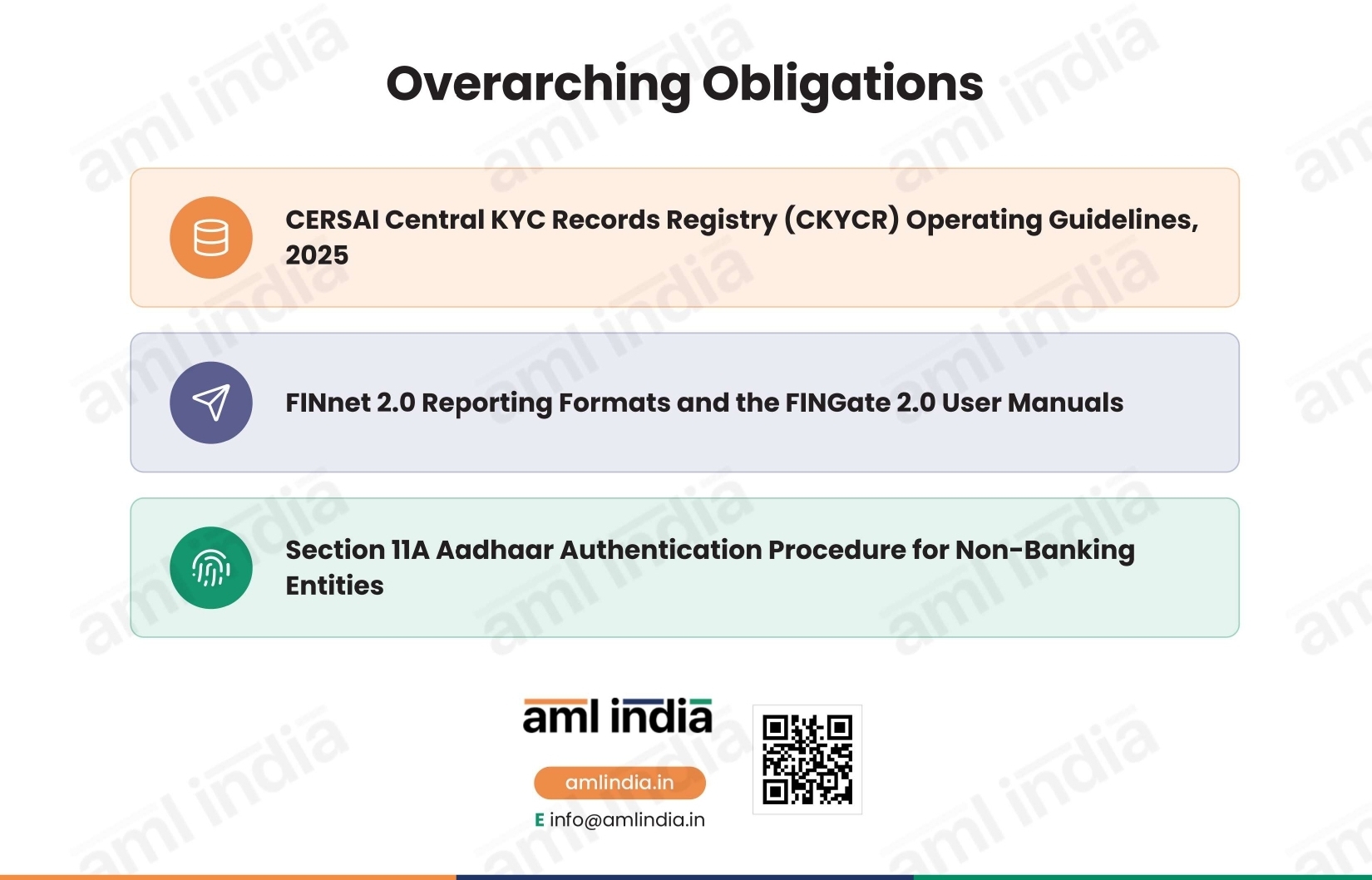
CERSAI Central KYC Records Registry (CKYCR) Operating Guidelines, 2025
The Central KYC Records Registry stores customer KYC records centrally. An India Post uploads to it and can reuse a customer’s existing record, keeping KYC consistent and reducing duplication. Getting beneficial ownership and identity data right for an institutional customer at onboarding is what makes the registry useful.
FINnet 2.0 reporting formats (2024) and the FINGate 2.0 user manuals
The FIU IND reporting platform and its current formats, through which an India Post enrols and files, with the FINGate 2.0 manuals covering enrolment, request response and reports.
Procedure for Aadhaar authentication under Section 11A of the PMLA (9 May 2019)
The procedure for reporting entities other than banking companies to apply to use Aadhaar authentication services, relevant where an India Post verifies an individual’s identity through Aadhaar.
Sectoral
The supervisor and its directions. The Reserve Bank of India regulates India Posts and issues the KYC Directions the institution works from, read with its consolidated master directions and internal risk assessment guidance.
Department of Posts
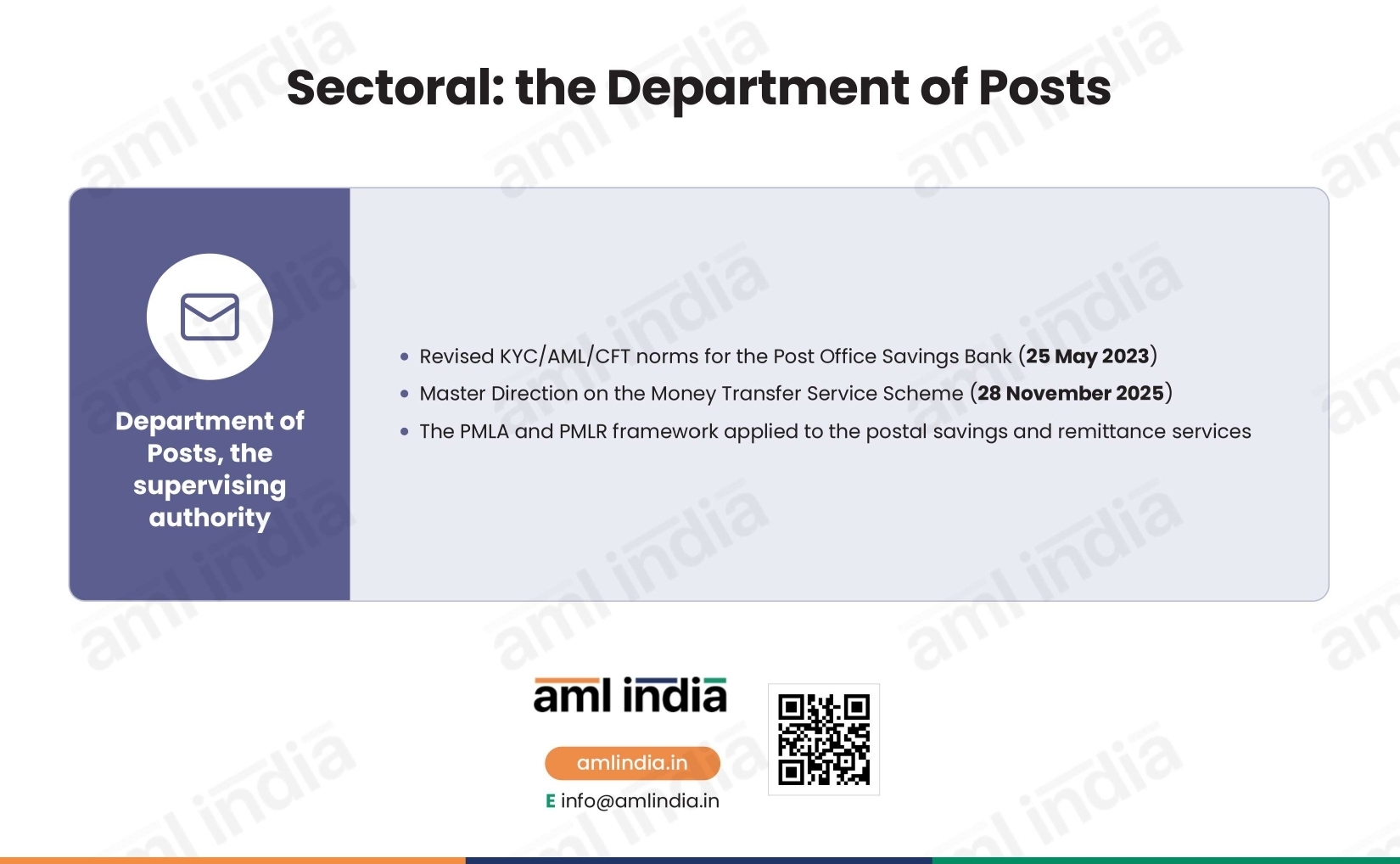
Revised KYC/AML/CFT norms for the Post Office Savings Bank (25 May 2023)
The sector rulebook, and the most important instrument on this page. On 25 May 2023, the Department of Posts revised the know your customer, anti money laundering and combating the financing of terrorism norms for the Post Office Savings Bank, setting out customer identification and due diligence, beneficial owner identification, record keeping, monitoring and reporting for the postal savings services. Where this article states a duty at the level of the law, these norms are where India Post finds the detail for its savings bank.
Master Direction on the Money Transfer Service Scheme
Under this framework, India Post acts as an Indian Agent to pay inbound cross-border personal remittances through designated post offices. The direction prescribes the KYC and reporting obligations applicable to remittance payouts.
The PMLA and PMLR framework applied to the postal financial services
Because India Post’s savings and designated remittance services constitute financial services for the purposes of the PMLA, the Department of Posts applies the PMLA and the PML Rules directly to it, with the Department of Posts norms providing the operational framework. The customer due diligence, beneficial owner identification, monitoring, reporting, record keeping and sanctions duties come from the PMLA and PMLR, applied across India Post’s covered financial activities.
Miscellaneous
Official reports and guidance that sit outside the binding rulebook but shape how India Post reads its risk and its duties.
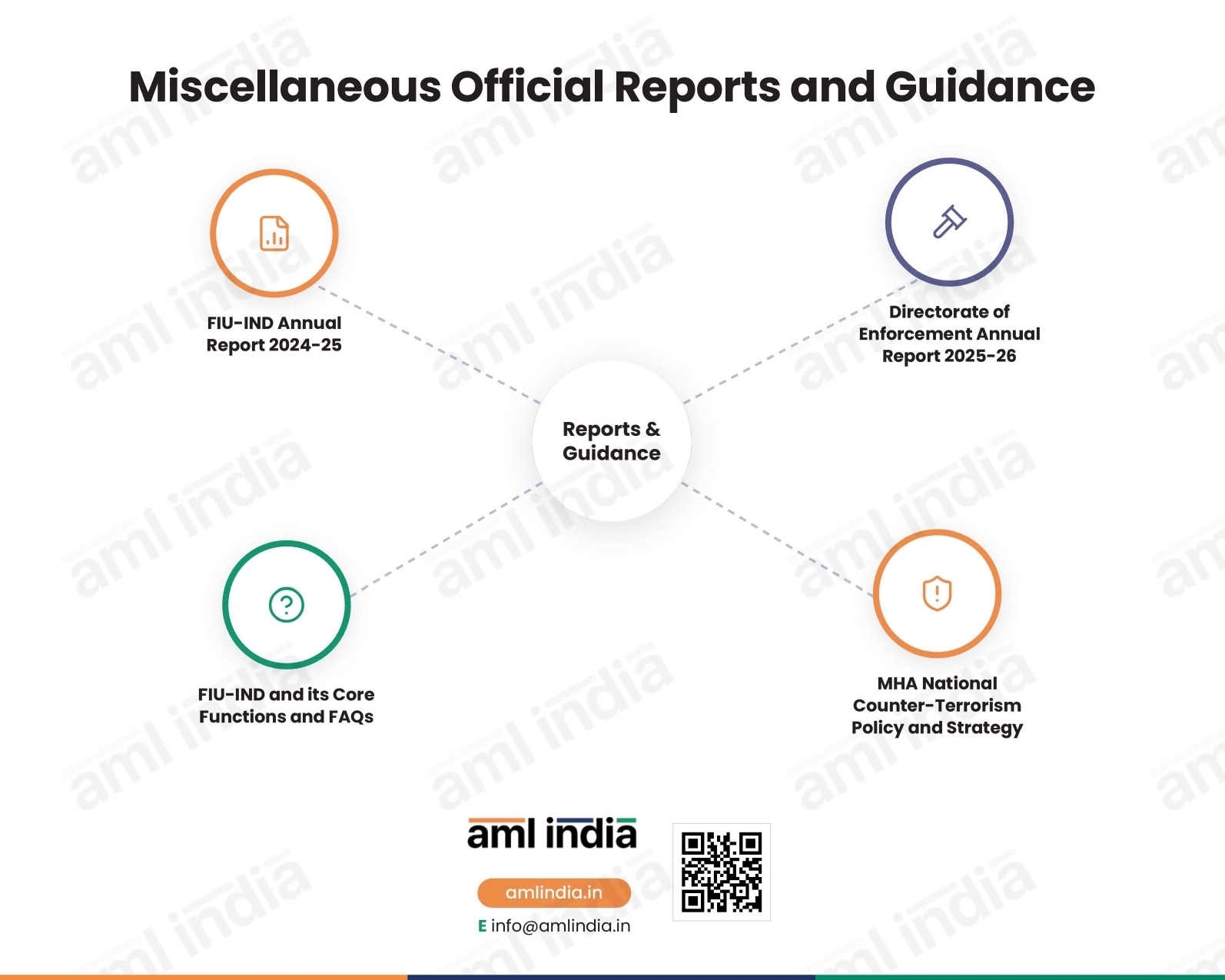
FIU IND Annual Report 2024 to 2025
The national FIU’s annual account of the reports it received, analysed and disseminated, a useful read on reporting volumes and priorities across reporting entity types.
Directorate of Enforcement Annual Report 2025 to 2026
The Enforcement Directorate’s annual account of investigations, provisional attachments and prosecutions under the PMLA, showing how the criminal enforcement end of the framework is used.
FIU IND and its Core Functions and FAQs
A guide that explains what FIU IND does and how reporting works, a useful primer for an institution’s reporting function.
MHA National Counter Terrorism Policy and Strategy
The Ministry of Home Affairs statement of national counter terrorism policy, which frames the CFT duties that Section 51A places on a regulated entity like India Post.
International Standards
The global benchmarks India is measured against, and the sources an India Post can use to calibrate a risk based approach.
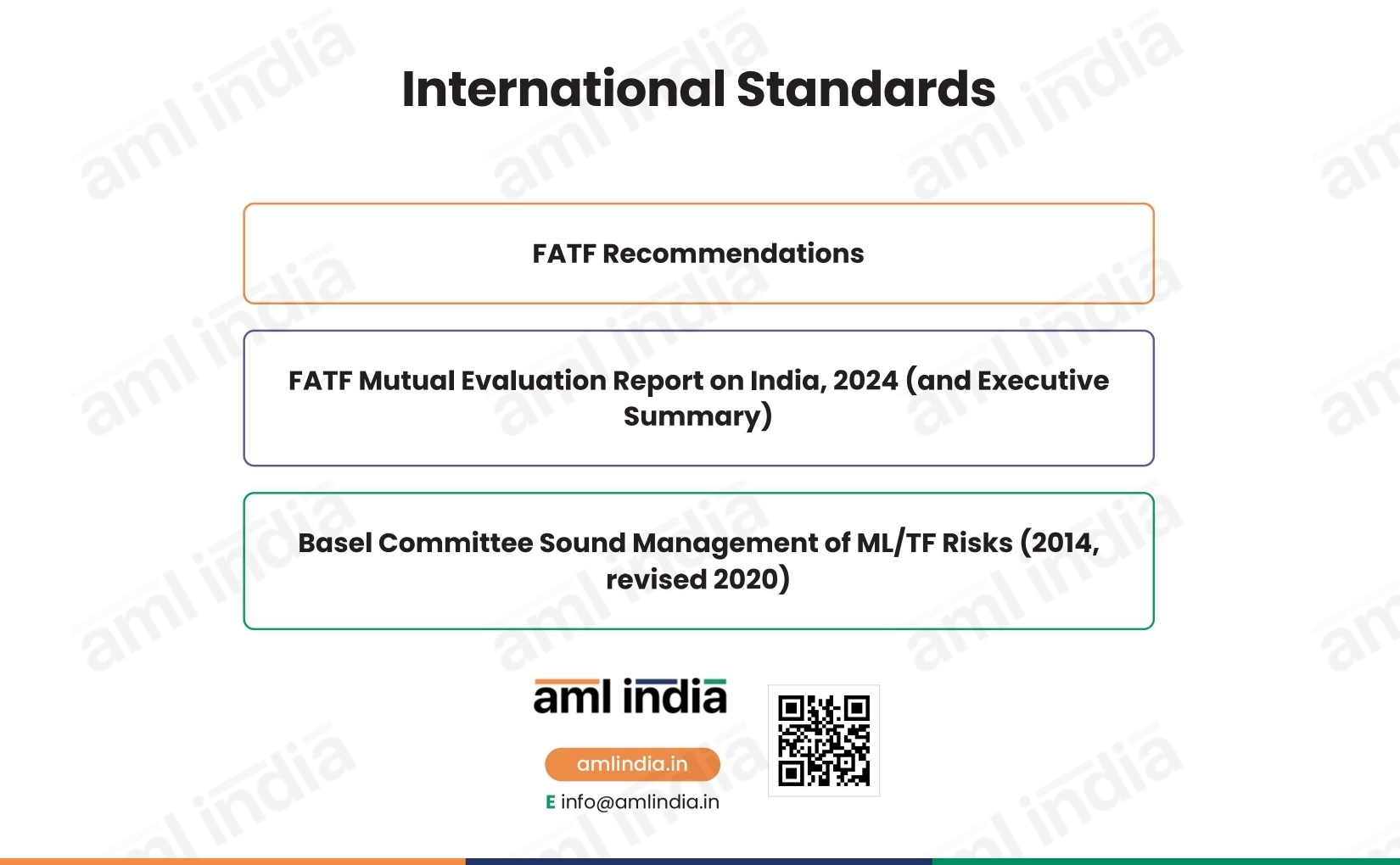
FATF Recommendations
The international AML, CFT and CPF standards. Recommendations 9 to 23 set the preventive measures for financial institutions, and Recommendation 6 on targeted financial sanctions was updated by FATF in June 2026. In addition to this, Recommendation 14 covers money or value transfer services. India’s framework for India Posts is built to meet them.
FATF Mutual Evaluation Report on India, 2024 (and Executive Summary)
The peer assessment of India’s AML and CFT system, which examined how the financial sector’s preventive measures and supervision work in practice.
Basel Committee, Sound Management of Risks Related to Money Laundering and Financing of Terrorism (2014, revised July 2020)
The Basel Committee guidance on managing ML and TF risk, a benchmark for the risk based approach and group wide controls that an India Post can read across to its own risk management.
FATF Risk Based Approach Guidance for the Banking Sector (2014)
FATF sector guidance on applying the risk based approach in banking and financial institutions, useful to an India Post in shaping its customer due diligence and monitoring.
Allied Laws
The wider body of law that defines each institution’s own mandate and the predicate offences and enforcement machinery around money laundering. India Post operates under the Indian Post Office Act, 1898, while the predicate and enforcement Acts shape the risk it must assess and the conduct it may need to report.
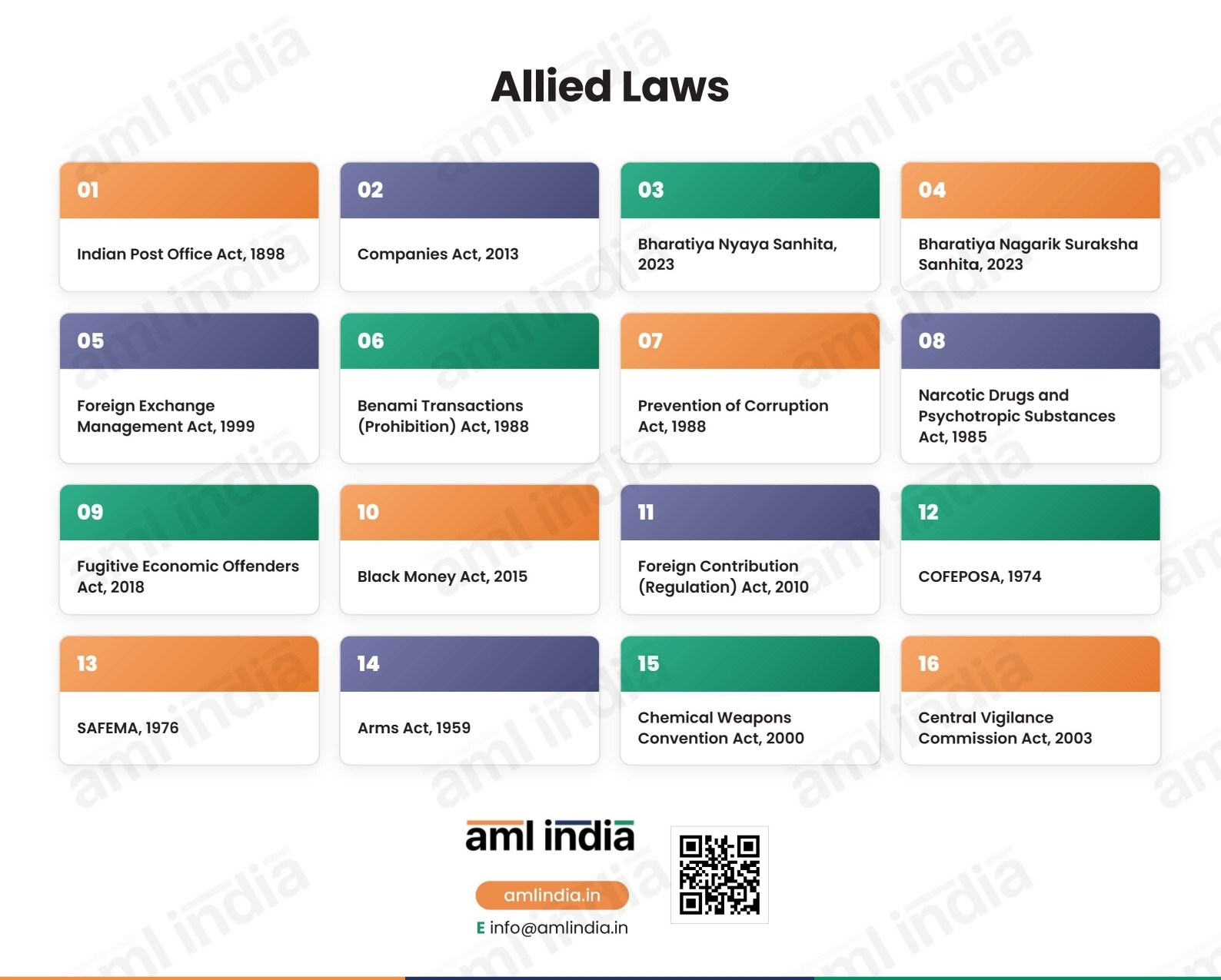
The allied laws applicable to India Post include the India Post Office Act, 1898, which shapes the framework for the entire sector, and the Foreign Exchange Management Act, 1999 (FEMA), under which the RBI authorises persons to deal in foreign exchange and supervises the business. Additionally, the Benami Transactions (Prohibition) Act, 1988 supports foreign exchange compliance.
The Companies Act, 2013, the Bharatiya Nyaya Sanhita, 2023, and the Bharatiya Nagarik Suraksha Sanhita, 2023 provide the governance in corporate, criminal law and procedural framework, respectively, which is applicable in cases of fraud, enforcement actions, and investigations.
The Prevention of Corruption Act, 1988, the Narcotic Drugs and Psychotropic Substances Act, 1985, the Fugitive Economic Offenders Act, 2018, the Black Money Act 2015 and Foreign Contribution (Regulation) Act, 2010, and the Chemical Weapons Convention Act, 2000 and outlines all the regulations pertaining to smuggling, prohibited arms, chemical weapons, and corruption oversight.
The Conservation of Foreign Exchange and Prevention of Smuggling Activities Act, 1974, the Arms Act, 1959, the Central Vigilance Commission Act, 2003 and the Smugglers and Foreign Exchange Manipulators (Forfeiture of Property) Act, 1976 also shape the allied law framework for India Post.
Core AML, CFT, CPF Obligations for India Post in India
Across that framework, the regulations require India Post to do the following. This article keeps each at the level required by law; a compliance requirements guide explains how to do each.
- Register with FIU IND. Enrol on the FINnet 2.0 / FINGate 2.0 portal so the institution can file its reports.
- Appoint officers. Appoint a Designated Director and a management level Principal Officer under Rule 7 of the PMLR and the RBI Directions. The same person cannot hold both roles, and both are informed to FIU IND and the RBI.
- Conduct the internal risk assessment. Run an ML and TF risk assessment across customers, products, channels and geographies, document it, and take its outcome to the board, as the RBI Directions and the IRA Guidance require.
- Document AML policy, controls and procedures. Adopt a board approved policy that turns the risk assessment into the institution’s operating procedures.
- Customer identification and CDD. Identify and verify every customer and the beneficial owner (a controlling interest of more than 10 per cent for a company or partnership, and more than 15 per cent for an unincorporated association or body of individuals, with the separate trust test), with enhanced due diligence for politically exposed persons and high risk customers, under Section 11A of the PMLA, Rule 9 of the PMLR and the RBI India Post KYC Directions 2025. The cash intensive, cross border nature of the business, customer identification at the point of exchange or remittance payout, and watching out for structuring and third party use becomes central.
- Ongoing monitoring and periodic updates. Monitor transactions on an ongoing basis, and refresh KYC at least once every 2, 8 and 10 years for high, medium and low risk customers. Review each customer’s risk categorisation at least once every six months.
- Sanctions screening. Screen customers and beneficial owners against the designated lists under Section 51A of the UAPA and Section 12A of the WMD Act, and freeze and report any match, verifying the relevant UNSC and domestic lists daily.
- Regulatory reporting. File cash transaction reports for cash above Rupees 10 lakh, suspicious transaction reports of any value, counterfeit currency reports and, for cross border remittance activity under the MTSS, cross border wire transfer reports of Rupees 5 lakh or more where applicable, under Rule 3 and Rule 8 of the PMLR. Cash and related reports are filed monthly, by the 15th day of the succeeding month; suspicious transaction reports are filed promptly, through FINnet 2.0.
- Record management, CKYCR and FINnet 2.0. Keep transaction records for five years from the date of the transaction, and identity records, account files and correspondence for five years after the relationship ends, under Section 12 of the PMLA. Upload customer KYC records to the CKYCR under Rule 9A, and file all prescribed reports through FINnet 2.0.
- Training and awareness. Train staff by role to apply the controls and recognise red flags in currency exchange and cross border remittance.
- Independent testing and audit. Test the programme through internal audit, compliance assurance or independent review, and close every finding.
- Run group wide controls. Where the institution has subsidiaries, apply AML and CFT programmes at group level, including for branches and majority owned subsidiaries, as the RBI Directions require.
What this article does not cover
This article explains the laws and regulatory instruments that apply to India Posts. It does not provide a control by compliance manual, and it does not restate each institution’s own establishing statute or its developmental mandate, except where they bear on the AML duties. For implementation, India Post separately documents customer acceptance, KYC and CDD procedures, beneficial owner identification, sanctions screening, transaction monitoring, suspicious transaction escalation, staff training, audit testing and board reporting. Those controls are the subject of the companion compliance guide.
To see how the India Post framework fits within the sector, see AML laws and regulations for financial institutions in India, and to place it within the national picture, see AML laws and regulations in India.
From regulation to compliance: your next step
Knowing the law is step one. These obligations only protect an institution when they are built into a working programme of risk assessment, policy, customer due diligence, monitoring, screening, reporting, training and independent review. For a India Post, customer identification at the point of exchange or remittance payout, monitoring for structuring, and sanctions screening are the controls that matter most. Understanding the stages of money laundering and how the sanctions screening process works is a useful starting point.
Want to confirm the 2025 directions for your institution?
AML India can walk you through the RBI India Post KYC Directions and build a proportionate programme for postal savings and remittance services.
Frequently Asked Questions
Yes, for its financial services. India Post’s Post Office Savings Bank and its money transfer and remittance services are financial services that make India Post a reporting entity under section 2(1)(wa) of the PMLA. The Department of Posts has issued KYC, AML and CFT norms for them. The ordinary mail and courier services are not financial services and are not covered on this basis.
The Department of Posts, housed under the Ministry of Communications, which operates the postal savings and remittance services and sets their KYC and AML norms. Reports are filed with the Financial Intelligence Unit India, and the Enforcement Directorate investigates and prosecutes the offence of money laundering. India Post is supervised within its own department.
The financial services: the Post Office Savings Bank, which offers savings accounts and the small savings schemes, and the money transfer service scheme and international money transfer, which pay out inbound cross border personal remittances. India Post Payments Bank is a separate payments bank covered under the banking framework, and the mail and logistics services are outside the AML framework.
Customer identification and KYC at account opening and at remittance payout, beneficial owner identification where a customer acts for another, ongoing monitoring for structuring across the branch network, sanctions screening, record keeping and reporting. The Department of Posts norms of 25 May 2023 for the Post Office Savings Bank set out how these apply in the savings bank.
Cash transaction reports for cash above Rupees 10 lakh, suspicious transaction reports of any value, counterfeit currency reports and, for the remittance service, cross border wire transfer reports of Rupees 5 lakh or more. Cash and related reports are filed monthly by the 15th of the succeeding month, and suspicious transaction reports promptly, through FINnet 2.0.
Yes. The screening duties under Section 51A of the UAPA and Section 12A of the WMD Act apply to India Post’s financial services throughout the network. India Post screens customers and beneficial owners against the United Nations and domestic designated lists and freezes and reports any match, whatever the value of the transaction.
Official sources and review
Last reviewed: July 2026. This guide is grounded in the following primary official sources, linked to their official source where available.
- Prevention of Money Laundering Act, 2002 (India Code)
- Prevention of Money Laundering (Maintenance of Records) Rules, 2005 (India Code)
- RBI (India Post Know Your Customer) Directions, 2025 (Reserve Bank of India)
- Foreign Exchange Management Act, 1999 (India Code)
- Unlawful Activities (Prevention) Act, 1967 and Section 51A procedure (MHA)
- WMD Act, 2005 and its Section 12A implementation procedure (India Code)
- FATF Recommendations, including the June 2026 update to Recommendation 6
- FATF Mutual Evaluation Report on India, 2024
- Basel Committee, Sound Management of Risks Related to ML and TF (2014, revised July 2020)
- Financial Intelligence Unit India, including the Annual Report 2024 25
- Central KYC Records Registry (CKYCR) Operating Guidelines, 2025 (CERSAI)
- Enforcement Directorate Annual Report 2025 to 2026
This guide covers money laundering law and compliance, a sensitive area where the rules change; confirm the current position for your institution with a qualified professional before acting.
Why work with AML India
AML India helps India Posts meet their PMLA and RBI obligations, from risk assessment and policy through to CDD, screening, monitoring, reporting, training and independent review.
Industries we serve: India Posts, NBFCs, housing finance, mortgage guarantee and asset reconstruction companies, insurers, payment system operators and aggregators, banks, DNFBPs, securities intermediaries and IFSC and GIFT City entities.
About the Author

Pathik Shah
FCA, CAMS, CISA, CS, DISA (ICAI), FAFP (ICAI)
Pathik is a Chartered Accountant with more than 26 years of experience in governance, risk, and compliance. He helps companies with end-to-end AML compliance services, from conducting Enterprise- Wide Risk Assessments to implementing the robust AML Compliance framework. He has played a pivotal role as a functional expert in developing and implementing RegTech solutions for streamlined compliance.

Reach Out to Pathik
