

Contact details
Phone No: +91 98248 84900
Email Id: [email protected]
FATF Grey List October 2026: DRC, Monaco, Bulgaria, and Côte d’Ivoire Removed
At its Plenary that concluded on 30 October 2026, the FATF removed DRC, Monaco, Bulgaria, and Côte d’Ivoire from the grey list. The updated FATF country list now has 18 jurisdictions under increased monitoring, while the blacklist is unchanged. Below is the complete list and what it means for reporting entities under India’s Prevention of Money Laundering Act, 2002 (PMLA).
Executive Summary:
October 2026 FATF update at a glance
- – Grey list additions: None
- – Grey list removals: DRC, Monaco, Bulgaria, and Côte d’Ivoire
- – Total grey-listed jurisdictions: 18
- – Blacklist: No change
- – India’s Vivek Aggarwal is FATF Vice-President (July 2026 to June 2027)
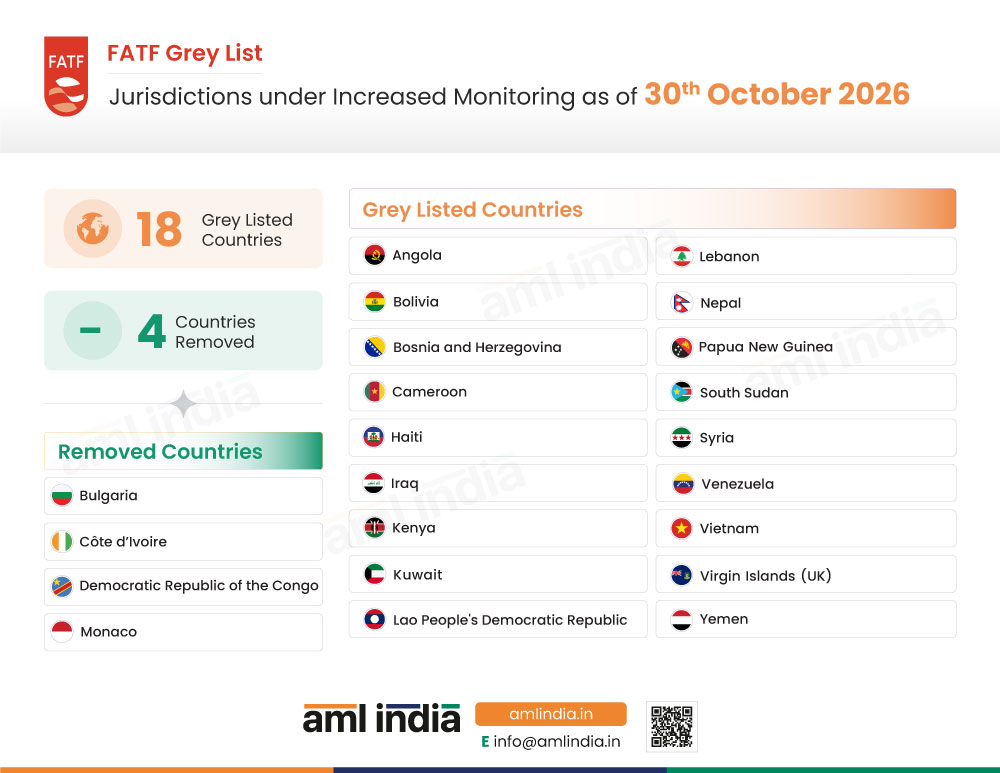
Updated FATF country list: grey list as of 30 October 2026
The FATF grey list names jurisdictions that are actively working with the FATF to fix strategic deficiencies in their regimes for countering money laundering, terrorist financing and proliferation financing. As of 30 October 2026, these 18 jurisdictions are on the list:
- Angola
- Bolivia
- Bosnia and Herzegovina
- Cameroon
- Haiti
- Iraq
- Kenya
- Kuwait
- Lao People’s Democratic Republic
- Lebanon
- Nepal
- Papua New Guinea
- South Sudan
- Syria
- Venezuela
- Vietnam
- Virgin Islands (UK)
- Yemen
FATF blacklist countries as of 30 October 2026
The FATF blacklist covers high-risk jurisdictions subject to a call for action. FATF members are asked to apply enhanced due diligence and, in the most serious cases, countermeasures.
- – Iran and DPRK: the FATF calls on members to apply countermeasures.
- – Myanmar: the FATF calls for enhanced due diligence proportionate to the risk, without disrupting humanitarian aid or remittance flows.
What changed at the October 2026 FATF Plenary
Countries added to the grey list
None
Countries removed from the grey list
DRC, Monaco, Bulgaria, and Côte d’Ivoire completed their action plans and passed on-site visits.
Grey list vs blacklist: the difference
| Point | Grey List | Blacklist |
|---|---|---|
| Cooperation with the FATF | Yes, under an agreed action plan | Limited or insufficient progress |
| Expected Response | Factor into risk assessment; EDD where risk warrants | EDD on all relationships; countermeasures where called for |
| Number of Jurisdictions | 18 | 3 |
What the update means for reporting entities in India
Banks, NBFCs, payment system operators, intermediaries, insurers, virtual digital asset service providers and other reporting entities must factor FATF statements into their risk-based approach. In practice, that means:
- – PMLA and PML Rules, 2005: apply enhanced due diligence to customers, beneficial owners and transactions connected to higher-risk jurisdictions, and keep records of the measures taken.
- – RBI KYC Master Direction: regulated entities must take into account the risks arising from deficiencies in the AML/CFT regimes of jurisdictions named in FATF statements.
- – FIU-IND reporting: a link to a listed jurisdiction is not by itself reportable, but it should prompt closer review, and suspicion must be reported through FINnet as an STR.
- – Sector regulators: SEBI, IRDAI and other regulators expect their regulated entities to reflect FATF list changes in policies and monitoring.
Action checklist for Indian compliance teams
- Update the country risk table in your customer risk assessment methodology.
- Refresh risk ratings and complete EDD where required; record your rationale.
- Update transaction monitoring scenarios and screening lists.
- Review whether enhanced measures for DRC, Monaco, Bulgaria, and Côte d’Ivoire remain justified.
- Brief the Principal Officer, Designated Director and front-line staff.
India and the FATF
India has been an FATF member since 2010 and is not on either list. Its 2024 mutual evaluation placed it in regular follow-up, the best outcome available. Indian official Vivek Aggarwal serves as FATF Vice-President for July 2026 to June 2027 under the UK Presidency.
FAQs on the FATF grey list update, October 2026
1. Which countries are on the FATF grey list in October 2026?
18 jurisdictions are on the grey list after the 30 October 2026 Plenary: Angola, Bolivia, Bosnia and Herzegovina, Cameroon, Haiti, Iraq, Kenya, Kuwait, Lao People’s Democratic Republic, Lebanon, Nepal, Papua New Guinea, South Sudan, Syria, Venezuela, Vietnam, Virgin Islands (UK), and Yemen.
2. Which countries are on the FATF blacklist?
As of October 2026, the FATF blacklist consists of Iran, North Korea (DPRK) and Myanmar.
3. Is India on the FATF grey list?
No. India is an FATF member, is not on the grey list or blacklist, and was placed in regular follow-up after its 2024 mutual evaluation.
4. What happens when a country is placed on the FATF grey list?
It commits to an action plan with deadlines, and other countries’ institutions treat links to it as higher risk, which can raise the cost of cross-border business.
5. How often does the FATF update its country list?
Three times a year, after its February, June and October Plenaries. The next update is due after the 22–26 February 2027 Plenary.
Is your country risk methodology up to date?
AML India helps reporting entities update risk assessments, KYC procedures and monitoring rules after every FATF update.


We are committed to assisting proper enforcement of AML and CFT regulations to regulated entities in India by designing a personalised AML framework – policies, internal controls, and procedures – and ensuring effective implementation of the same.
Important Links
subscribe to newsletter
© AML India 2023 All Rights Reserved.

